LEAD TIME
Lead times per material, in plain numbers
How long a sculpture takes depends on material and size. Below is what you can expect - and how we plan backwards from your date, so the delivery date in the proposal holds.
1 to 50,000 pieces
From a single piece to a large edition

ISO 9001
Certified quality management system
EcoVadis Platinum
Sustainability at the highest level

Supplier of the Year 2025
Winner of the prestigious industry award
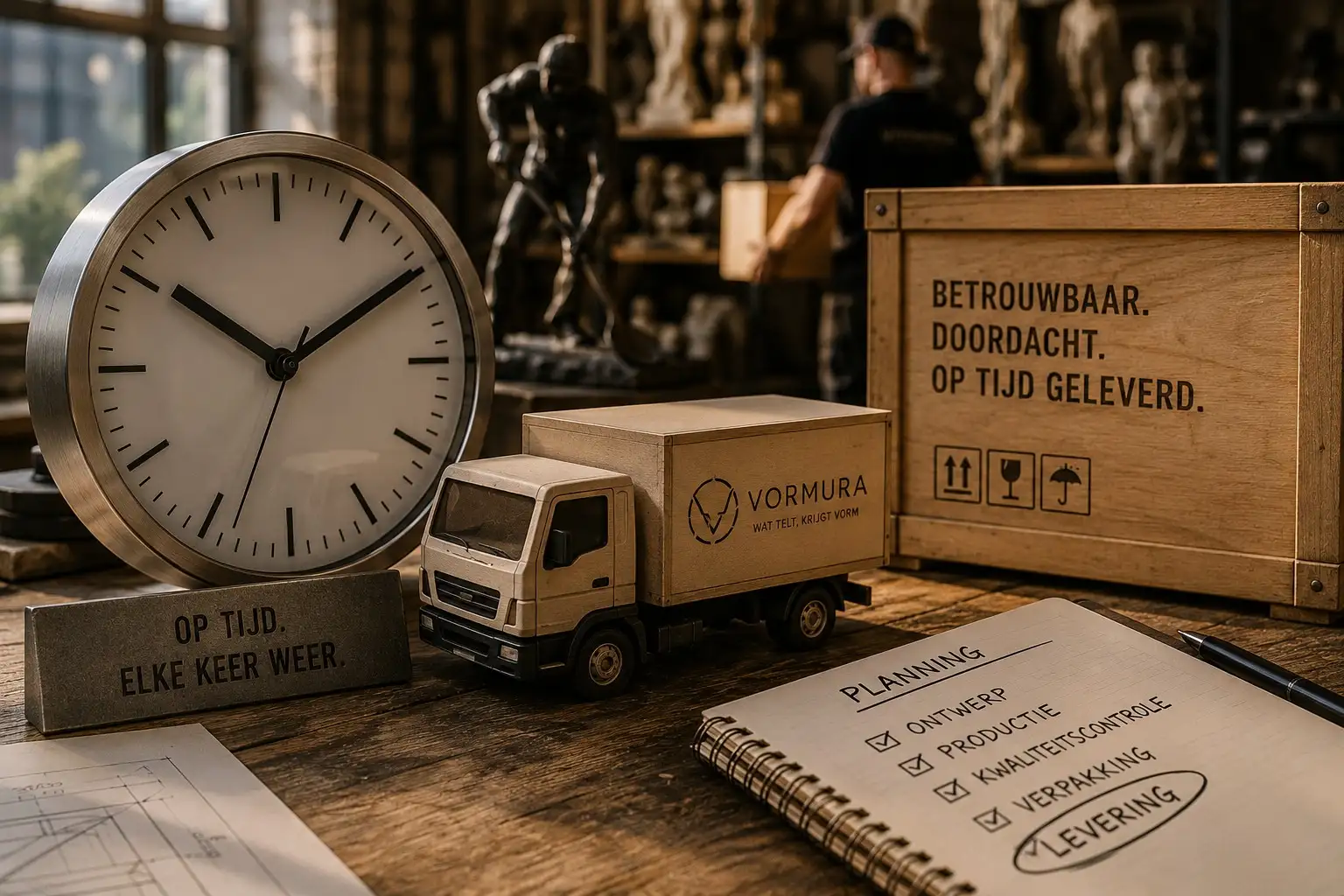
Lead time varies by material: 3D printing is usually the fastest, bronze takes the most time. If you are working towards a fixed day, we plan backwards from that date and fix the delivery date in the proposal.
Lead times per material
| Material | Lead time | Where the time goes |
|---|---|---|
| Bronze | 10 - 14 weeks | mould making, casting, finishing and patinating |
| 3D print | 2 - 3 weeks | printing runs continuously, finishing is done by hand |
| Stainless steel | 8 - 12 weeks | welding, grinding and polishing |
| Bronzed tin alloy | 6 - 8 weeks | mould making, casting and bronzing |
| Cast iron | 6 - 8 weeks | mould and casting process |
| Resin | 6 - 8 weeks | mould making, casting and finishing |
| Ceramics | 4 - 6 weeks | building up, drying and firing (the firing process cannot be sped up) |
| Paverpol clay | 2 - 3 weeks | building up and curing |
| Wood | 2 - 3 weeks | drying and carving |
| Glass | 6 - 8 weeks | shaping and cooling |
What determines the lead time
- The material: casting and firing have their own pace; printing runs continuously while nothing happens at the table.
- The size: larger means more production steps and often more finishing.
- The design phase: the sooner the story is clear and the proof is approved, the sooner production starts. This phase can usually be influenced; production itself cannot.
- The placement: a sculpture with a foundation or anchoring requires preparation on site.
Planning backwards from your date
In the first conversation, name the date of the unveiling, the reception or the fair opening. We plan backwards: production, proof stage, design and briefing, with margin for the placement. That gives the latest start date - and that, together with the delivery date, is fixed in the proposal.
When it gets tight
Sometimes the date is closer than the material allows. If so, we say so straight away, and discuss what is possible: a different material with a shorter lead time, an adjusted size, or an unveiling in two steps - the design presented on the day itself, the sculpture placed shortly after. What we do not do is promise a date we cannot meet.
Plan backwards from your date
Name the day that is fixed; you will hear straight away whether it is feasible.